

Executive summary:
A 10-day pilot revealed that ChatGPT Ads serve primarily as a powerful B2B intent-sourcing engine rather than a direct performance or conversion channel. While initial campaigns generated zero direct conversions, leveraging third-party de-anonymization tools such as Factors.ai, Apollo.io, or Snitcher on landing pages effectively revealed the specific companies behind anonymous clicks, thereby transforming AI-native traffic into valuable in-market accounts.
In this B2B pilot, ChatGPT ads worked better as an intent-sourcing engine than as a conversion driver. While the potential for intent-sourcing is clear, navigating the current iteration of the platform is not without its hurdles.
To help others avoid the same pitfalls, we’ve identified the main challenges that defined our experience.
Here are the three hurdles we kept hitting
- The creative is bare-bones: each ChatGPT ad has one headline, one description, and a 256×256 image so small that most brands just drop a logo in and call it done
- Bidding is vague: the system suggests a CPC, says competitors are outbidding you, but never says who, by how much, or what it’d take to win. From what we’ve seen, CPCs tend to hover around $5–7, and CPMs are loosely in the $25–35 range, but treat that as a ballpark, not a benchmark — the auction is opaque and still shifting as more advertisers show up.
- Reporting tells you almost nothing. Spend, impressions, clicks, CPC. That’s it.
So we cracked it ourselves.
Here’s where the analysis turns strategic. Instead of accepting the platform’s word that this campaign did nothing, we built our own measurement layer around it — UTMs on every link, GA4 wired up, first-party capture on the landing page, and de-anonymization running underneath it all through Factors.ai, Apollo.io, and Snitcher. That’s the tracking puzzle nobody hands you the pieces for. ChatGPT won’t tell you which companies clicked. But if you own the landing page, you can reverse-engineer it yourself, matching visits to real accounts rather than to anonymous line items in a dashboard.
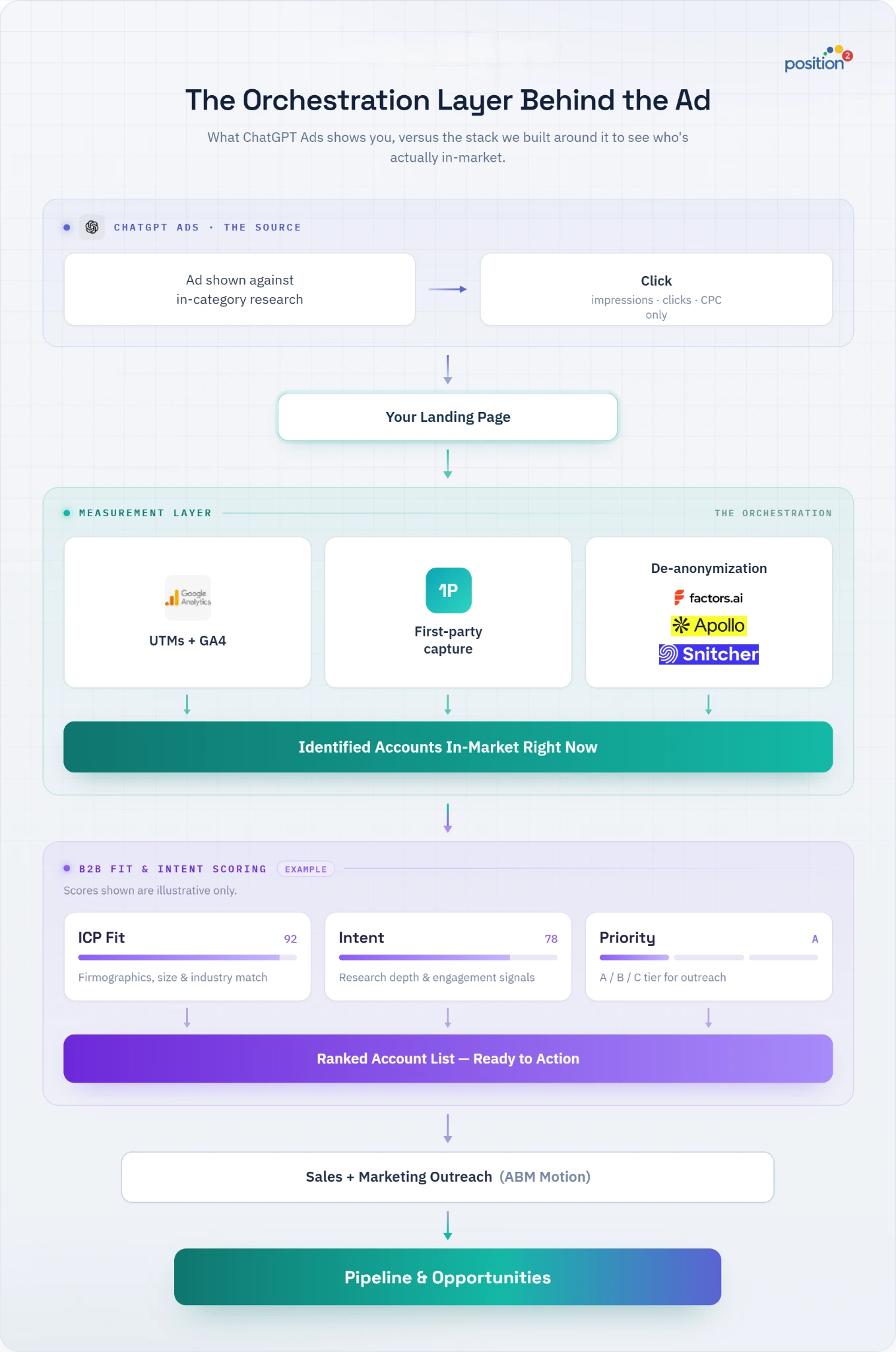
The orchestration layer we built around ChatGPT Ads to turn clicks into identified, actionable accounts.
Once we ran that data, the campaign looked completely different. Zero conversions, sure. But a real list of companies that had been mid-research in ChatGPT about exactly our category and had clicked through after seeing ads on ChatGPT. Nobody bought anything off a 256×256 ad — nobody ever does in B2B, that’s not how a commercial decision or ChatGPT commercial strategy works. What we got instead was something more valuable than a sale: proof of who was already circling the category, before they’d talked to a single competitor.
What this actually means for B2B
A growing share of the B2B buying journey now starts in an AI assistant rather than a search bar, prompting many to ask, Does ChatGPT have ads? A director scoping vendors, a VP building a shortlist — a lot of that early digging happens in ChatGPT before anyone fills out a form or takes a call. When your ChatGPT ads show up against those conversations, the click isn’t a lead. It’s a flare going up: somebody in your category is actively looking, right now. The strategic job is figuring out who.
Grading that on conversions is like judging a metal detector by how much money it spends. The asset here was never the sale — it’s the early knowledge that an account is in-market, before your competitors discover it.
And that’s the part in your control. ChatGPT won’t identify your traffic for you, but you can. Point the ad at a landing page worth visiting, run de-anonymization on whoever shows up, and you’ve replaced the platform’s reporting with your own. A campaign with zero conversions quietly becomes a warm account list. Same $200, completely different outcome, depending on whether you bothered to look.
The payoff shows up as pipeline, not purchases — sales and marketing reaching the right people at the right companies while they’re still researching, not after they’ve already picked a vendor. You track that with account engagement and opportunities created, not a two-week ROAS check.
This approach, redefining OpenAI advertising, shows how targeted placement turns general interest into actionable accounts.
The Position² Take
After ten days, our strategic read: for B2B, ChatGPT advertising isn’t a performance channel, it’s an intent-sourcing one. Ask it to close deals, and it’ll disappoint you. Ask it to reveal who’s researching your category inside AI, and it earns its keep. The clicks were never the point — the list of accounts behind advertising in ChatGPT is.
So the play is simple: point the ads at a solid landing page, de-anonymize that traffic, and hand the identified accounts to sales and marketing for direct outreach. The ad doesn’t close anyone, it tells you who to call.
Our recommendations
- Run a small, instrumented pilot, not a media buy — the $25/day minimum makes every dollar cheap tuition.
- Wire up de-anonymization from day one, using Factors.ai, Apollo.io, or Snitcher, so you can see which companies are actually landing on your page.
- Route identified accounts straight to sales and marketing for direct outreach while the account is still researching. Treat it as an ABM intent engine, not an ad campaign.
- Test truncated copy — the “…” version pulled ~2.5x more clicks in our run, and more relevant traffic means more accounts worth identifying.
- Own your measurement: UTMs on every link, GA4 wired up, first-party capture on the landing page. Assume the platform tells you nothing on its own.
- Send traffic somewhere worth identifying — a genuinely useful page, not a hard-sell pitch.
- Keep spend modest while it’s this early: under ~5K for B2C. This is a learning line, not a growth line.
- Avoid: grading it on conversions, running it without de-anonymization, scaling on the platform’s own numbers, chasing the “competitors are outbidding you” nudge, or pulling budget from proven channels.
The brands that win the AI-native era won’t be the ones who spent the most on day one. They’ll be the ones who worked out how to read intent on a brand-new surface and had the orchestration ready to act on it the moment it showed up.
That’s the position we’re building for our clients, and if you’re trying to wire up an AI-surface intent pipeline of your own, that’s exactly the kind of work we do.
Frequently Asked Questions
Do ChatGPT Ads work well as a performance channel for B2B?
No, it does not work well as a performance channel for B2B. The campaign produced zero conversions, so grading it on immediate ROI or purchases is the wrong measure. Its value is in identifying accounts that are already researching the category.
What is the main value of ChatGPT Ads for B2B teams?
Its main value is intent sourcing. The ads can surface in-market accounts researching specific AI assistant categories, giving sales and marketing a signal that an account is actively looking. That makes the channel more useful for ABM than for direct response.
Why do landing page tools matter for ChatGPT Ads?
Landing page tools matter because ChatGPT does not identify who clicked the ad. By using de-anonymization tools on the landing page, marketers can reveal the companies behind anonymous visits and turn clicks into identifiable accounts. That is what changes the campaign from a vague ad buy into a warm account list.
What kind of measurement setup is needed to make this work?
A useful setup includes UTMs on every link, GA4, first-party capture on the landing page, and background de-anonymization. This creates a measurement layer that replaces the platform’s limited reporting. Without that, the platform only shows spend, impressions, clicks, and CPC.
Should ChatGPT Ads be optimized for conversions?
No, it should not be optimized for conversions in this use case. The useful outcome is account identification and pipeline support, not immediate purchases. The campaign should be judged on account engagement and the opportunities it creates, rather than on a short-term ROAS check.
What practical approach is recommended for running these ads?
The recommended approach is to run a small, instrumented pilot, send traffic to a useful landing page, and wire up de-anonymization from day one. Truncated ad copy is worth testing because it pulled more clicks in the pilot. Spending should stay modest while the platform is still early.